
IColours
Colour used for this page of the library: Shu vermilion #EB6101. Every colour code is approximate, since most paths name their colours without publishing codes.
Principal colour the colour of the path
The colour of torii and shrine halls at many shrines. Fushimi Inari explains shu as a colour that repels evil forces, and at this shrine it expresses the abundant power of the kami Inari. The old shu pigment contained mercury, which helped preserve wood.
The colour of the saifuku (斎服) ritual robe worn alike by priests of every status, of the shide paper on the ōnusa wand, and of the white kimono (白衣, hakui) of the miko.
Place of worship real sanctuaries
Ritual colours by occasion and season
The saifuku is a plain white robe with plain white trousers, the same for every status.
The ōnusa wand carries white shide paper streamers used for purification.
The colour of the robe (袍, hō) changes by status. See the dress section.
Mourning and avoided colours
Attendees at a Shinto funeral (神葬祭, shinsōsai) wear standard mourning dress as at Buddhist funerals: black suits for men, black, dark blue or grey for women. Fur is avoided because it suggests killing.
During the fifty-day ki (忌) period, the family covers the kamidana with white paper, suspends worship and does not visit shrines. The fuku (服) period lasts one year.
IIRanks
Shinto has no single central church. Most shrines (jinja) belong to the Jinja Honchō (神社本庁, Association of Shinto Shrines), which grants priestly ranks (階位, kaii) and status grades (身分, mibun) to priests. Some major shrines stand outside the Jinja Honchō, and Ise Jingū has its own system of titles.
- 1Gūji (chief priest)宮司 (gūji)
- 2Gon-gūji (associate chief priest)権宮司 (gongūji)
- 3Negi (senior priest)禰宜 (negi)
- 4Gon-negi (priest)権禰宜 (gonnegi)
- 5Shusshi (trainee)出仕 (shusshi)
- 1Gūji (chief priest) 宮司 (gūji) · Chief priest
The representative and head of a shrine. A gūji needs the rank of Gon-seikai or higher, and Meikai or higher at designated shrines.
- 2Gon-gūji (associate chief priest) 権宮司 (gongūji) · Assistant chief priest
Deputy representative. Only at certain shrines permitted to have this post.
- 3Negi (senior priest) 禰宜 (negi) · Priest
Assistant to the gūji.
- 4Gon-negi (priest) 権禰宜 (gonnegi) · Junior priest
Priest in the general service of the shrine.
- 5Shusshi (trainee) 出仕 (shusshi) · Apprentice
A trainee, not regarded as a full priest.
Followers: Ujiko (氏子, people of the area a shrine protects), sūkeisha (崇敬者, devotees). These terms were not checked against sources in this round of research.. There are no grades of believers.
IIIForms of address
| Rank | Spoken address | In writing | Self reference | Original term |
|---|---|---|---|---|
| Gūji | Japanese say 宮司さん (gūji-san). No Vietnamese form of address among believers, no source found. | The title goes before or after the shrine name, e.g. 伏見稲荷大社宮司. Suggested Vietnamese rendering: "Cung tư" (宮司, Gūji). | no source found | 宮司 |
| All priests | Visitors commonly say 神主さん (kannushi-san). This is a colloquial term, not an official title. | 神職 (shinshoku, Shinto priest) is the official general term. | no source found | 神主, 神職 |
| Miko | 巫女さん (miko-san) | Miko (巫女, shrine maiden). Vietnamese: "Vu nữ" | no source found | 巫女 |
IVVestments by rank
Flat drawings made from the descriptions in the sources, with no people shown. Colours are approximate.
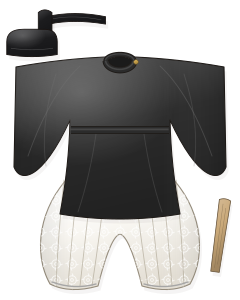




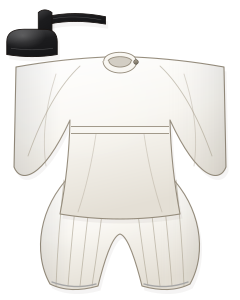

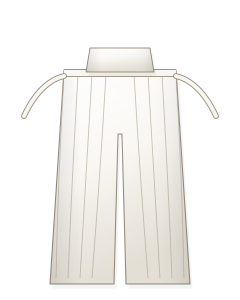
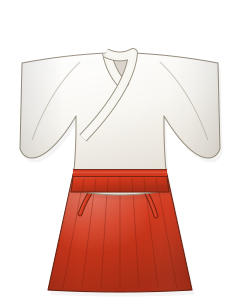
VLine of succession
Shinto has no founder and no common head. The tradition runs through shrines, and many shrines pass the priesthood down within families. Today most shrines belong to the Jinja Honchō (Association of Shinto Shrines), whose honorary head is the Tōri and whose executive is the President (Sōchō). Ise Jingū is its Honsō (head shrine), with the office of Saishu held by a woman of imperial birth.
Shinto: milestones from myth to canon and schools
- mythological ageAmaterasu Ōmikami 天照大御神 (Amaterasu Ōmikami)
Sun goddess enshrined at the Inner Shrine of Ise, regarded as ancestral kami of the imperial house. Shinto has no human founder.
- legendary ageYamatohime-no-mikoto 倭姫命 (Yamatohime no Mikoto)
Legendary princess credited with settling Amaterasu at Ise, herself enshrined at Yamatohime-no-miya.
- died 723, presented the Kojiki in 712Ō no Yasumaro 太安万侶
Compiled the Kojiki (712) from the recitation of Hieda no Are, the oldest record of Japanese myth.
- 676 to 735, presented the Nihon Shoki in 720Prince Toneri 舎人親王
Led the compilation of the Nihon Shoki (720), the first official chronicle.
- begun 905, completed 927Fujiwara no Tokihira, Fujiwara no Tadahira 藤原時平, 藤原忠平
Oversaw the Engishiki (927), whose Jinmyōchō registers 2,861 shrines and 3,132 kami.
- 1256 to 1351 (approximate)Watarai Ieyuki 度会家行
Outer Shrine priest who systematized Ise Shinto.
- 1435 to 1511Yoshida Kanetomo 吉田兼倶
Founded Yoshida Shinto, which licensed shrine priests through the Edo period.
- 1730 to 1801Motoori Norinaga 本居宣長
Kokugaku scholar whose Kojiki-den restored the Kojiki to the center of Shinto thought. Enshrined as a kami at Motoori Norinaga-no-miya.
- 1776 to 1843Hirata Atsutane 平田篤胤
Leader of Restoration Shinto, enshrined as a kami at Hirata Jinja.
- 1868Shinbutsu bunri orders (Meiji) 神仏判然令
Meiji orders separating kami and buddhas, beginning State Shinto.
- 15 December 1945Shinto Directive 神道指令
Allied directive ending State Shinto.
- founded 3 February 1946Jinja Honchō (Association of Shinto Shrines) 神社本庁
Umbrella body of about 80,000 shrines, with Ise as its head shrine.
- #9 · Tōri since 2018Takatsukasa Naotake, Tōri 鷹司尚武 (統理)
Ninth Tōri, the spiritual and ceremonial head of Jinja Honchō, since 2018.
- #19 · President since 2010, sixth term from May 2025Tanaka Tsunekiyo, President 田中恆清 (総長)
Chief executive of Jinja Honchō since 2010, confirmed by courts after the 2022 succession dispute, re-elected for a sixth term in 2025.
- Saishu since 19 June 2017Kuroda Sayako, Saishu of Ise Jingū 黒田清子 (神宮祭主)
Supreme priestess of Ise Grand Shrine since 2017, daughter of Emperor Emeritus Akihito.
Jinja Honchō: successive Tōri
- #1 · 1946Hasegai Toyoo 長谷外余男
First Tōri.
- #2 · 1946 to 1959Takatsukasa Nobusuke 鷹司信輔
Shaped the postwar association.
- #3 · 1959 to 1975Sasaki Yukitada 佐佐木行忠
Third Tōri.
- #4 · 1976 to 1989Tokugawa Munesada 徳川宗敬
Fourth Tōri.
- #7 · 2001 to 2011Kuni Kuniaki 久邇邦昭
Seventh Tōri.
- #8 · 2011 to 2018Kitashirakawa Michihisa 北白川道久
Eighth Tōri.
- #9 · from 2018Takatsukasa Naotake 鷹司尚武
Current Tōri.
Full list of 9 holders
- 1Hasegai Toyoo (長谷外余男)1946
- 2Takatsukasa Nobusuke (鷹司信輔)1946 to 1959
- 3Sasaki Yukitada (佐佐木行忠)1959 to 1975
- 4Tokugawa Munesada (徳川宗敬)1976 to 1989
- 5Hosokawa Morisada (細川護貞)1989 to 1998
- 6Higashizono Motofumi (東園基文)1998 to 2001
- 7Kuni Kuniaki (久邇邦昭)2001 to 2011
- 8Kitashirakawa Michihisa (北白川道久)2011 to 2018
- 9Takatsukasa Naotake (鷹司尚武)from 2018
Ise Grand Shrine: the Saishu
- c. 593 to 608Nakatomi no Mikeko 中臣御食子
First Saishu in the traditional list, of the Nakatomi clan.
- 1839 to 1871Fujinami Noritada 藤波教忠
Last hereditary Saishu, dismissed by the Meiji government.
- 1947 to 1974Kitashirakawa Fusako 北白川房子
Daughter of Emperor Meiji, first postwar Saishu.
- 1974 to 1988Takatsukasa Kazuko 鷹司和子
Daughter of Emperor Shōwa.
- 1988 to 2017Ikeda Atsuko 池田厚子
Daughter of Emperor Shōwa.
- from 19 June 2017Kuroda Sayako 黒田清子
Current Saishu.
Full list of 5 holders
- Prince Nashimoto Morimasa (梨本宮守正王)1937 to 1947
- Kitashirakawa Fusako (北白川房子)1947 to 1974
- Takatsukasa Kazuko (鷹司和子)1974 to 1988
- Ikeda Atsuko (池田厚子)1988 to 2017
- Kuroda Sayako (黒田清子)from 2017
A venerated figure: the library shows no portrait, only the name inside a round seal.
VIOrdination and transmission
There is no transmission by ordination vows. Priests receive a rank (階位, kaii) from the Jinja Honchō after training, then are appointed to a post (職階, shokkai) at a shrine. The six status grades (身分, mibun) are set by the Jinja Honchō according to experience and merit, and determine the colours of robe and trousers. Many shrines are still passed down within families.
- Rank of Chokkai (直階)Requirement: Completion of training or a courseRite: Granted by the Jinja Honchō
- Rank of Gon-seikai (権正階)Requirement: Sufficient to be gūji of an ordinary shrineRite: Granted by the Jinja Honchō
- Rank of Seikai (正階)Requirement: Required for negi at designated shrinesRite: Granted by the Jinja Honchō
- Rank of Meikai (明階)Requirement: Can be reached through training courses. Required for gūji of designated shrinesRite: Granted by the Jinja Honchō
- Rank of Jōkai (浄階)Requirement: The highest rank, not reachable by training aloneRite: Granted by the Jinja Honchō
- Six status grades: Yonkyū, Sankyū, Nikyū, Nikyū-jō, Ikkyū, TokkyūRequirement: Experience, character, and service to the shrine and to ShintoRite: Set by the Jinja Honchō, shown by the colours of robe and trousers
VIIWhere the sources disagree
- The old colour in mau-sac.json is #A32A1D, labelled as torii vermilion. This code matches neither shu (朱 #EB6101) nor any traditional colour name checked. If a deeper tone is needed, a named colour such as 弁柄 bengara #8F2E14 or 赤錆 #8A3319 would be better, but no source was found saying torii use these two colours.
- mau-that.json gives wall #F3EEE4, wood #B8895A and accent #C8372D for than-dao. The accent #C8372D is not shu (朱 #EB6101). The old note on the place of worship (white plaster, shide, hinoki wood, vermilion pillars) is on the right track but should separate two types: shrines painted in shu such as Fushimi Inari, and unpainted wooden shrines such as Ise Jingū.
- The assignment says Shuten. The correct name of the trainee grade is 出仕, read shusshi.
- Robe colour for Sankyū and Yonkyū: Japanese Wikipedia gives 紺袍 (dark blue). Some other sources call this colour 縹 (hanada, a lighter blue). No original Jinja Honchō regulation was available for comparison.
- Trouser (hakama) colours with jōsō: Hotokami and Futagami Shrine agree on white with white pattern for Tokkyū, purple with white pattern for Ikkyū, purple with pale purple pattern for Nikyū-jō, purple for Nikyū, and asagi light blue for Sankyū and Yonkyū. The Futagami Shrine blog says there are about one hundred Tokkyū, while Hotokami says Ikkyū are only about one percent of priests.
- Miko do not need priestly qualification. At Ise Jingū the system of titles is entirely different (祭主, 大宮司, 少宮司, 禰宜, 権禰宜, 宮掌).
- No direct source was found for the nibiiro (鈍色) colour of priestly dress at Shinto funerals, so it is not included.
- Hex codes follow the 和色大辞典 (colordic.org) and are approximate screen colours. The codes for hinoki wood and thatch are estimates, not standard codes.
- Since May 2022 the presidency has been disputed: Tōri Takatsukasa Naotake named Ashihara Takahide, while the board of officers re-elected Tanaka Tsunekiyo. The Tokyo District Court (12/2022), the High Court (6/2023) and the Supreme Court (2/10/2024) all upheld Tanaka. In May 2025 he was chosen for a sixth term. Some major shrines such as Tomioka Hachimangū have left the Jinja Honchō over internal conflicts.
- The user called 統理 "Tổng lý". The standard Sino-Vietnamese reading is "Thống lý". It is an honorary and ceremonial office, distinct from the President (総長, Sōchō), who runs the organisation.
- The starting years of Ikeda Atsuko (1988) and Takatsukasa Kazuko (1974) come from general knowledge. The Japanese Wikipedia page on the Saishu only lists up to 1871. Check further if the years are displayed.
- Outside the Jinja Honchō there are also independent shrines (Yasukuni, Fushimi Inari Taisha) and the 13 Sect Shinto (教派神道) groups, each with its own founder. This set does not list those groups.
- Motoori Norinaga and Hirata Atsutane are marked sacred because both are enshrined as kami at their own shrines. Commons has public domain images of both (Motoori's 1773 self-portrait, an Edo-period painting of Hirata) if the Teacher wishes to use them.
- No free images of Tōri Takatsukasa Naotake or President Tanaka Tsunekiyo were found on Commons.
- The images of Takatsukasa Nobusuke, Kitashirakawa Fusako and Takatsukasa Kazuko use the original files because they are small. The image of Kuroda Sayako was taken in 2016, before she became Saishu.
VIIISources
27 sources
- https://ja.wikipedia.org/wiki/%E7%A5%9E%E8%81%B7
- https://en.wikipedia.org/wiki/Kannushi
- https://hotokami.jp/articles/111/
- https://www.hutagami.com/blog/171891/
- https://kyokoku.org/%E7%A5%9E%E9%81%93%E3%83%BB%E7%A5%9E%E8%81%B7%E3%81%AB%E3%81%A4%E3%81%84%E3%81%A6/%E7%A5%9E%E8%81%B7%E3%81%A8%E9%9A%8E%E4%BD%8D/
- https://inari.jp/about/faq/
- https://www.isejingu.or.jp/about/architecture/
- https://ja.wikipedia.org/wiki/%E5%B7%AB%E5%A5%B3
- https://www.colordic.org/w
- https://www.jinjahoncho.or.jp/omairi/bukki/
- https://www.santai-jinja.jp/blog/shinsousai-manner/
- https://www.japanese-shrines.com/662/
- https://ja.wikipedia.org/wiki/%E7%A5%9E%E7%A4%BE%E6%9C%AC%E5%BA%81
- https://keibatsugaku.com/jinja_honcho/
- https://www.chugainippoh.co.jp/article/news/20241220-004.html
- https://gendai.media/articles/-/151905?page=2
- https://ja.wikipedia.org/wiki/%E7%A5%AD%E4%B8%BB
- https://ja.wikipedia.org/wiki/%E9%BB%92%E7%94%B0%E6%B8%85%E5%AD%90
- https://rirc.or.jp/database/?rircdb=14738
- https://rirc.or.jp/database/?rircdb=13736
- https://www.jinjahoncho.or.jp/sys/9967
- https://www.chugainippoh.co.jp/article/news/20250526-001.html
- https://en.wikipedia.org/wiki/Kojiki
- https://en.wikipedia.org/wiki/Nihon_Shoki
- https://en.wikipedia.org/wiki/Engishiki
- https://en.wikipedia.org/wiki/Motoori_Norinaga
- https://en.wikipedia.org/wiki/Hirata_Atsutane
?Quick Questions
What is the principal colour of Shinto?
Shu vermilion (朱 (shu), 朱色), #EB6101. Shu (朱) is a named colour in the traditional Japanese palette, tied to the torii that mark a Shinto shrine, and explained by Fushimi Inari itself. It pairs with the white (白) of the saifuku and shide. Note that shu is fairly bright. Bold text on it should use black or kon (紺) dark blue, which is also a named colour in the priestly dress system.
How many ranks does Shinto have?
The library records 5 ranks, from highest to lowest: Gūji (chief priest), Gon-gūji (associate chief priest), Negi (senior priest), Gon-negi (priest), Shusshi (trainee).
Who leads Shinto today?
In the line of Shinto: milestones from myth to canon and schools, the most recent milestone is Kuroda Sayako, Saishu of Ise Jingū (Saishu since 19 June 2017). Supreme priestess of Ise Grand Shrine since 2017, daughter of Emperor Emeritus Akihito.