IOverview
The Confucian religion in Indonesia, Agama Khonghucu, is Confucianism organised as a religion in the full administrative sense. It has a supreme council, houses of worship called litang, clergy and a scripture, and the Indonesian state recognises it as one of six official religions. Its supreme council is MATAKIN.
This is a basic difference from Confucianism in China, Vietnam or Korea, where it is mainly a scholarly and ritual tradition. Indonesian law requires every citizen to list a religion on official documents, so Confucian Chinese Indonesians organised themselves as a religion in order to be recognised and protected.
IIHistory
- 1883 to 1906Surabaya's Temple of ConfuciusThe Boen Tjhiang Soe temple was founded in 1883 and rebuilt in 1906 as Boen Bio, a Temple of Confucius still used for worship.
- 17 March 1900Tiong Hoa Hwee KoanA Chinese association in Batavia founded as a social and educational organisation in a Confucian spirit.
- 1918 to 1923Confucian associationsThe Confucian association of Solo was founded in 1918. A congress in Yogyakarta in 1923 created the first central council.
- 1955Supreme councilAccording to English Wikipedia, the supreme council took the name MATAKIN on 16 April 1955. Indonesian Wikipedia dates the name MATAKIN to 1966.
- 1965RecognitionUnder Sukarno, Confucianism was among the six recognised religions.
- 1967 to 1979RestrictionPresidential Instruction No. 14 of 1967 curbed the public practice of Chinese religion and custom. In 1979 the Suharto government withdrew recognition.
- 2000 to 2006RestorationPresident Abdurrahman Wahid revoked the 1967 instruction by Decree No. 6 of 2000. Imlek became a national holiday from 2003. In 2006 Confucianism was reconfirmed as an official religion.
IIITeachings and Distinctive Features
As Indonesian Confucians present it, the religion worships Tian, Heaven, as the supreme being. Confucius is called Nabi Kongzi, the prophet or holy teacher of Heaven's way. The scriptures are the Four Books and the Five Classics, translated into Indonesian from the late 19th century and treated as holy writ. The faith teaches a virtuous life, filial piety, reverence for ancestors and harmony between Heaven, Earth and humanity.
This framing uses concepts familiar from other Indonesian religions, such as a supreme being, a prophet and scripture. Scholars see it both as a reading of Confucianism with its own roots in Kang Youwei's movement to make Confucianism a state religion, and as an adaptation to Indonesian law, which defines religion on a model with a supreme being and a holy book.
The Confucian religion is often equated with worship at Chinese temples, known as klenteng. In fact many klenteng honour Buddhist, Daoist and Confucian figures together in the Three Teachings style called Tri Dharma. The litang is the dedicated house of worship of organised Confucianism. The two are closely related but not the same.
IVRitual and Community Life
Confucians gather at the litang, usually on the first and fifteenth days of the lunar month, for prayer, scripture teaching and hymns. The greatest festival is the Lunar New Year, called Imlek in Indonesia, counted by the Kongzili calendar that dates from Confucius's birth. Other observances include Confucius's birthday and death anniversary, ancestral offerings and weddings under the religion's own rite, recognised by the state since 2006.
From 1968 to 1999, Confucians could not celebrate the New Year publicly. Many registered as Buddhists or Christians during this period to obtain valid papers, so the number declaring Confucianism fell sharply.
VOrganisation and Distribution
MATAKIN is the national supreme council. Local associations called MAKIN are usually attached to a litang. Indonesia's Ministry of Religious Affairs has a centre for Confucian guidance and education. A common emblem of the faith is the wooden bell, recalling Confucius as the bell that awakens the world.
| Point | Figure | Source and year | Note |
|---|---|---|---|
| 1971 census | 954,584, about 0.8 percent | insideindonesia.org | Before recognition was withdrawn |
| 2022 census | 74,899, about 0.03 percent | Wikipedia citing the 2022 census | Bangka Belitung 29,738, West Kalimantan 15,809, West Java 12,198 |
| Population registry, May 2022 | 71,999 | databoks.katadata.co.id | Administrative data, distinct from the census |
VIIn Vietnam
There is no Confucian religious community on the Indonesian model in Vietnam. Chinese Vietnamese worship at assembly halls and temples, many honouring several figures in the Three Teachings manner, but no Confucian organisation presents itself as a religion. Confucianism is also not among the 16 religions recognised by the Vietnamese state.
VIISymbol of the Branch
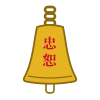
Wooden bell clapper
Genta, Bok Tok, 木鐸
VIIIOther Branches of Confucianism
 Cheng-Zhu Neo-Confucianism宋明理學 程朱學派, School of PrincipleThe school that built a full cosmology on principle and qi, with the investigation of things as its path.
 Classical Confucianism先秦儒家, pre-Qin ConfuciansThe Confucianism of Confucius, Mencius and Xunzi, concerned with ethics and government rather than metaphysics.
 Lu-Wang School of Mind陸王心學, 陽明心學 (Xinxue)Holds that principle lies in the mind rather than in external things.Uses the common symbol of the pathHan Confucianism漢儒, Han-era Confucian learningDong Zhongshu urged setting aside other schools and making Confucianism the sole state orthodoxy.Uses the common symbol of the pathQing Evidential Learning考證學 kaozhengxue, 樸學, Han learning 漢學In the Qing, scholars turned to philological research to recover the sages' words, called Han learning in contrast to the moral philosophy of Song learning.Uses the common symbol of the pathNew Confucianism新儒家, 當代新儒學A 20th-century current answering the May Fourth critique, accepting Western science and democracy while keeping the learning of mind and nature.Uses the common symbol of the path
 Vietnamese ConfucianismNho học, Hội Tư văn, Văn MiếuConfucianism became a system in Vietnam under the Lý, with the Temple of Literature in 1070, the first examination in 1075 and the Imperial Academy in 1076.Korean Confucianism, Sungkyunkwan성균관 成均館 Seonggyungwan, 유교 YugyoSungkyunkwan was founded in Hanyang on 25 September 1398 and is today Korea's Confucian body.Uses the common symbol of the pathConfucian Religion in IndonesiaAgama Khonghucu, MATAKIN (Majelis Tinggi Agama Khonghucu Indonesia)Confucianism organised as a religion with a council, houses of worship and rites, one of Indonesia's six officially recognised religions.
IXSources
The library cross-checks the sources below. Where they disagree, the page gives both.
?Quick Questions
Why is Confucianism an official religion in Indonesia?
Indonesian law requires citizens to list a religion on their papers. Confucians organised as a religion with a council and houses of worship. It was recognised in 1965, derecognised in 1979 and reconfirmed in 2006.
What is MATAKIN?
The Supreme Council for the Confucian Religion in Indonesia, the national body of the faithful. Local MAKIN associations are attached to litang.
How many Confucians are there in Indonesia?
About 74,899, or 0.03 percent of the population, in the 2022 census as cited by Wikipedia. In 1971 the self-declared figure was 954,584, but the two cannot be compared directly because the legal context differed.
What does Imlek have to do with Confucianism?
For Confucians, Imlek is the greatest festival, counted by the Kongzili calendar. It has been a national holiday in Indonesia since 2003.