
IOverview
Vietnamese Confucianism is the way Vietnamese people received, taught, examined and lived by Confucian learning for nearly a thousand years. It became a system under the Lý dynasty, with the Temple of Literature in 1070, the first examination in 1075 and the Imperial Academy in 1076. It became dominant under the early Lê, continued under the Nguyễn, and ended as an institution with the last examination in 1919.
In Vietnam it is a scholarly and moral tradition, not a church. There is no head, no register of believers and no clergy. A nhà nho, or Confucian scholar, was someone who had studied the classics, not someone initiated into a faith. So there is no way to count followers today, even though its traces are present in almost every Vietnamese household.
IIHistory
- 1st to 3rd centuriesUnder Chinese ruleGovernors Xi Guang and Ren Yan taught ritual, and Shi Xie (Sĩ Nhiếp) was later honoured as the founding teacher of the south. Influence remained narrow.
- 1070 to 1076The Lý lay the foundationsTemple of Literature in 1070, first examination in 1075, Imperial Academy in 1076.
- 14th centuryChu Văn AnTeacher at the Imperial Academy under the Trần, later honoured at the Temple of Literature in Hanoi.
- 1428 to 1527Early Lê dominanceIn just over a century, 26 doctoral examinations produced 989 doctors. Stelae for laureates began in 1484.
- 1808 to 1834The NguyễnTemple of Literature in Huế built in 1808, schools extended to prefectures and districts in 1823, and Minh Mạng's Ten Moral Precepts issued in 1834.
- 1919The last examinationThe final metropolitan and palace examinations were held in Huế, closing 844 years of examinations.
According to the Temple of Literature, the system held 183 major examinations producing 2,898 doctors and secondary laureates. Figures vary with how examinations and dynasties are counted, so these should be read as one source's numbers rather than the only figure.
IIIDistinctive Features
Doctrinally, Vietnamese Confucianism followed the Song school and read the Four Books through Zhu Xi. Yet it had features of its own. First, it lived alongside Buddhism, Daoism and local belief. Many scholars served the state as Confucians while visiting pagodas and honouring village guardian spirits. Second, it was tied to self-rule: Vietnamese studied Chinese script and sat Chinese-style examinations in order to build a state of their own. Third, loyalty to the ruler and filial piety received the strongest emphasis and became the core of family custom.
A common mistake is to treat every traditional custom as Confucian. Ancestor worship may have local roots older than Confucianism, which supplied its ritual form and its explanation through filial piety. Village communal houses honouring guardian spirits, burning paper offerings and choosing auspicious days are not in the Confucian family ritual manuals.
IVLeading Scholars
| Person | Dates | Legacy |
|---|---|---|
| Chu Văn An | 1292 to 1370 | Teacher at the Imperial Academy under the Trần, honoured at the Temple of Literature |
| Lê Thánh Tông | Reigned 1460 to 1497 | Made Confucianism dominant, issued 24 moral instructions |
| Nguyễn Bỉnh Khiêm | 1491 to 1585 | Scholar of the Mạc period and teacher, popularly known as Trạng Trình |
| Lê Quý Đôn | 1726 to 1784 | Polymath of the restored Lê, author of many major works |
| Hồ Sĩ Tân | 1690 to 1760 | Author of the Thọ Mai family ritual manual still used for funerals |
| Trần Trọng Kim | 1883 to 1953 | Wrote the survey Nho giáo in the early 1930s, a summation of Confucian learning in modern Vietnamese script |
VStudy, Examinations, Rites and Family Ritual
Vietnamese Confucianism lived on four levels. At court there was the Temple of Literature, with sacrifices to Confucius in spring and autumn. In the village there was the Hội Tư văn, the association of educated men, who conducted rites at the văn chỉ or văn từ, shrines to Confucius and to the village's own laureates. In the lineage there were clan halls, genealogies and clan memorials. In the household there was the ancestral altar, with funerals, death anniversaries and weddings following manuals such as the Thọ Mai gia lễ.
VIToday
Confucianism is not among the 16 religions recognised by the Vietnamese state, and no organisation represents it. The Temple of Literature in Hanoi is managed by the Văn Miếu Quốc Tử Giám Centre for Cultural and Scientific Activities. It hosts ceremonies for top graduates, New Year calligraphy and rites for Confucius. Its 82 doctoral stelae, recording examinations from 1442 to 1779, were added to UNESCO's Memory of the World register in 2011.
Beyond Hanoi there are the Mao Điền temple in former Hải Dương, now part of Hải Phòng, Xích Đằng in Hưng Yên, the Huế temple of 1808 and the Vĩnh Long temple of 1866. Many study-promotion associations and lineages still hold rites at village văn chỉ.
The deepest trace remains family custom: the ancestral altar, death anniversaries by the lunar calendar, genealogies still being updated, and sayings such as honour teachers and respect learning, or learn manners before letters. Vietnamese Confucianism today is less a doctrine people choose than a cultural layer they live with.
VIISymbol of the Branch
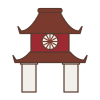
Khuê Văn Các
奎文閣
VIIIOther Branches of Confucianism
 Cheng-Zhu Neo-Confucianism宋明理學 程朱學派, School of PrincipleThe school that built a full cosmology on principle and qi, with the investigation of things as its path.
 Classical Confucianism先秦儒家, pre-Qin ConfuciansThe Confucianism of Confucius, Mencius and Xunzi, concerned with ethics and government rather than metaphysics.
 Lu-Wang School of Mind陸王心學, 陽明心學 (Xinxue)Holds that principle lies in the mind rather than in external things.Uses the common symbol of the pathHan Confucianism漢儒, Han-era Confucian learningDong Zhongshu urged setting aside other schools and making Confucianism the sole state orthodoxy.Uses the common symbol of the pathQing Evidential Learning考證學 kaozhengxue, 樸學, Han learning 漢學In the Qing, scholars turned to philological research to recover the sages' words, called Han learning in contrast to the moral philosophy of Song learning.Uses the common symbol of the pathNew Confucianism新儒家, 當代新儒學A 20th-century current answering the May Fourth critique, accepting Western science and democracy while keeping the learning of mind and nature.Uses the common symbol of the pathVietnamese ConfucianismNho học, Hội Tư văn, Văn MiếuConfucianism became a system in Vietnam under the Lý, with the Temple of Literature in 1070, the first examination in 1075 and the Imperial Academy in 1076.Korean Confucianism, Sungkyunkwan성균관 成均館 Seonggyungwan, 유교 YugyoSungkyunkwan was founded in Hanyang on 25 September 1398 and is today Korea's Confucian body.Uses the common symbol of the path
 Confucian Religion in IndonesiaAgama Khonghucu, MATAKIN (Majelis Tinggi Agama Khonghucu Indonesia)Confucianism organised as a religion with a council, houses of worship and rites, one of Indonesia's six officially recognised religions.
IXSources
The library cross-checks the sources below. Where they disagree, the page gives both.
?Quick Questions
Is Confucianism a recognised religion in Vietnam?
No. It is not among the 16 religions recognised by the state and has no representative body. The Temple of Literature is a heritage site managed by cultural authorities.
When was Vietnam's last Confucian examination?
In 1919, under Emperor Khải Định, in Huế. The ceremony of 24 May 1919 announced seven doctors and sixteen secondary laureates, ending 844 years of examinations.
What was the Hội Tư văn?
The association of educated men in a traditional village. It led rites at the văn chỉ or văn từ, shrines to Confucius and to the village's laureates, and helped uphold learning and custom locally.
How many doctoral stelae are at the Temple of Literature?
Eighty-two survive, recording examinations from 1442 to 1779. UNESCO added them to the Memory of the World register in 2011.