IOverview
The Christian and Missionary Alliance, usually shortened to CMA or simply the Alliance, is an evangelical Protestant denomination. Vietnamese speakers call it Liên Hiệp Phúc Âm or just CMA.
On a world scale it is a mid-sized family, far smaller than the Baptists or Pentecostals. For Vietnam, though, it holds a special place. The CMA opened the first permanent Protestant mission on Vietnamese soil in 1911, and the two largest Protestant bodies in the country today both grew out of that work.
Its best known hallmark is a short summary of faith called the Fourfold Gospel, which presents Jesus as Saviour, Sanctifier, Healer and Coming King. Those four themes also appear as four objects on the emblem of the Evangelical Church of Vietnam.
IIHistory
The founder was Albert Benjamin Simpson, a Canadian born Presbyterian minister. In 1887 he set up two parallel bodies, one to deepen the spiritual life of believers from any denomination and one to send missionaries abroad. In 1897 they merged as the Christian and Missionary Alliance.
At first the Alliance saw itself as an interdenominational mission, not a new church. Over the 20th century its North American congregations took on the full structure of a denomination. Overseas its policy was to plant self-governing, self-supporting and self-propagating national churches, which in 1975 formed the Alliance World Fellowship.
- 1887Simpson founds two societiesOne for spiritual renewal, one for foreign missions, both based in New York.
- 1897MergerThe two societies unite as the Christian and Missionary Alliance.
- 1911Arrival in Da NangR. A. Jaffray, P. M. Hosler and G. L. Hughes open a station at Tourane, today's Da Nang.
- 1927First general assemblyChurches in Vietnam meet in Da Nang and form a national body, later known as the Evangelical Church of Vietnam.
- 1975Alliance World FellowshipNational churches of CMA origin form a common forum with no authority over its members.
IIIBeliefs and Distinctives
At its core the Alliance shares the ground of evangelical Protestantism: Scripture as final authority, salvation by grace through faith in Jesus, and a duty of every believer to bear witness. It affirms the Trinity and the historic creeds.
The Fourfold Gospel, as the Alliance itself presents it, has four parts:
- Saviour: sins are forgiven through the death and resurrection of Jesus.
- Sanctifier: after conversion the believer is filled with the Spirit to live a holy life.
- Healer: God still heals today, and the church prays for and anoints the sick.
- Coming King: Jesus will return, and world evangelisation is tied to that hope.
The emphasis on healing puts the Alliance close to Pentecostalism on one point, but the two differ clearly. The Alliance does not teach that speaking in tongues is the required sign of being filled with the Spirit. Its well known formula is to seek not, forbid not.
It baptises those who profess faith, usually by immersion, and keeps communion as a memorial.
IVWorship, Rites and Daily Life
A Sunday service in a church of CMA origin usually includes hymns, prayer, Bible reading, a sermon and an offering. Communion is often held once a month.
Mission has been central since the founding. Alliance churches typically hold special mission offerings and run Bible schools to train workers. In Vietnam the first Bible school opened in Da Nang in 1921, according to the Evangelical Church of Vietnam's own records.
No. The CMA is a denomination within Protestantism, one church family among many. Some Vietnamese call every Protestant a CMA member because the Alliance arrived first, but the Baptist, Presbyterian, Mennonite and Pentecostal bodies in Vietnam are not part of it.
VOrganisation and Distribution
In the United States the Alliance holds a regular general council and has a national office. Worldwide, each national church of CMA origin is autonomous. The Alliance World Fellowship is a forum for fellowship, not a governing body.
According to Alliance World Fellowship figures cited by English Wikipedia, member churches counted about 6.7 million people in 24,000 congregations across 88 countries in 2024.
VIIn Vietnam
According to the Evangelical Church of Vietnam, on 25 May 1911 R. A. Jaffray, Paul M. Hosler and G. Lloyd Hughes arrived in Tourane and bought two plots, numbers 66 and 67, for the first mission station. In 1927 the first general assembly met in Da Nang and created a common body for the churches.
Sources disagree on when that body split in two. Some date it to after the Geneva Accords of 1954, others to the period after 1975. Both accounts agree that today there are two separate organisations, each with its own charter, executive board and general assembly.
| Organisation | Recognised | Size | Headquarters |
|---|---|---|---|
| Evangelical Church of Vietnam (North) | 1958 per the Government Committee for Religious Affairs, some English sources give 1963 | 1,415 churches and meeting points, 220,000 members, nearly 1,000 clergy, reported at the April 2026 assembly | Hanoi Protestant Church, Ngo Tram Street |
| Evangelical Church of Vietnam (South) | 3 April 2001 | Over 700,000 members, nearly 600 churches, 1,500 meeting points in 34 provinces, reported at the July 2022 assembly | 155 Tran Hung Dao, Ho Chi Minh City |
The name of the Vietnam Evangelical Missionary Alliance Church, registered in 2018 according to the Government Committee for Religious Affairs, echoes the CMA. The library has not found a document confirming any link, so it is not listed under this branch.
VIISymbol of the Branch
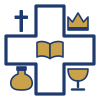
Emblem of the Evangelical Church of Vietnam
Giáo hiệu HTTLVN
VIIISub-branches
- Evangelical Church of Vietnam (North)
- Evangelical Church of Vietnam (South)
IXOther Branches of Protestantism
 Pentecostal ChurchesPentecostalismThe youngest and fastest growing family, stressing that gifts of the Holy Spirit such as speaking in tongues, healing and prophecy are active today.
 Reformed and Presbyterian ChurchesReformed, PresbyterianStems from Zwingli in Zurich and Calvin in Geneva.
 Anglican CommunionAnglicanismSeparated from Rome in England in 1534, keeping bishops and the Book of Common Prayer.
 Methodist ChurchesMethodismGrew from John Wesley's movement within 18th-century Anglicanism and became separate after 1791.
 Lutheran ChurchesLutherische KircheThe first family, beginning with Martin Luther in 1517, with the Augsburg Confession of 1530 as its basic creed.
 BaptistsBaptistsBegins with John Smyth in Amsterdam in 1609.Uses the common symbol of the path
 Seventh-day AdventistsSeventh-day Adventist ChurchFormed in 19th-century America from the movement awaiting Christ's return.Christian and Missionary Alliance (CMA)Christian and Missionary AllianceFounded by A.
 Anabaptist and Mennonite ChurchesAnabaptism, MennonitesBegan in Zurich on 21 January 1525.
XSources
The library cross-checks the sources below. Where they disagree, the page gives both.
?Quick Questions
What is the CMA in Protestantism?
CMA stands for the Christian and Missionary Alliance, an evangelical denomination founded by A. B. Simpson in New York and merged in 1897. In Vietnam it opened the first Protestant mission station, in Da Nang in 1911.
What is the Fourfold Gospel?
It is the Alliance's summary of four things it believes about Jesus: Saviour, Sanctifier, Healer and Coming King. On the emblem of the Evangelical Church of Vietnam they appear as a cross, an oil flask, a communion cup and a crown.
How do the northern and southern Evangelical Churches of Vietnam differ?
Both share CMA roots and the same doctrine but are separate organisations with their own charters and boards. According to the Government Committee for Religious Affairs, the northern body was recognised in 1958 and the southern body on 3 April 2001.
Does the CMA teach speaking in tongues like Pentecostals?
The Alliance believes God still heals and that spiritual gifts remain active, but it does not treat tongues as a required sign. That is the main difference between the Alliance and Pentecostal churches.