
IOverview
The Lutheran churches descend directly from Martin Luther and the German Reformation. They usually call themselves evangelical, evangelisch in German, while the name Lutheran was given by outsiders. Luther himself objected to believers being named after him.
Of all the Protestant families, the Lutherans kept the most of the old liturgy: vestments, candles, altars, in many places the crucifix, and in the Nordic countries bishops. What they changed was doctrine, centred on justification by faith.
IIHistory
On 31 October 1517 Luther, a friar and professor at Wittenberg, published his 95 Theses against the sale of indulgences. The dispute led to his excommunication in 1521. He translated the Bible into German, wrote hymns and produced two catechisms in 1529.
In 1530 Philipp Melanchthon drafted the Augsburg Confession, presented to the Emperor. The Peace of Augsburg in 1555 let German princes choose Lutheranism or Catholicism for their lands. The Nordic kingdoms also turned Lutheran in the 16th century, making it the national church of Sweden, Denmark, Norway, Finland and Iceland. Emigrants later carried it to America, and missionaries to Africa and Asia.
- 151795 Theses31 October, the conventional start of the Reformation.
- 1530Augsburg ConfessionThe foundational confession of the Lutheran churches.
- 1580Book of ConcordThe Lutheran confessional writings gathered in one collection.
- 1947Lutheran World FederationFounded in Lund, Sweden.
- 1999Joint Declaration with CatholicsThe Lutheran World Federation and the Holy See sign the Joint Declaration on the Doctrine of Justification in Augsburg.
IIIBeliefs and Distinctives
- Justification by faith: God forgives by grace alone, through faith in Christ, not by works. Lutherans call it the article on which the church stands or falls.
- Law and Gospel: God's word both exposes sin and announces forgiveness, and the preacher must distinguish the two.
- Real presence: in communion the body and blood of Christ are truly present in, with and under the bread and wine.
- Priesthood of all believers: every baptised person stands directly before God.
Lutherans baptise infants and see baptism as a means of grace. On church images Luther took a relaxed view, neither requiring their removal nor their retention, which is why Lutheran churches in Germany and Scandinavia often still hold pre-Reformation art.
No. Luther is remembered as a teacher and Bible translator, not prayed to. The name Lutheran came about against his own wishes.
IVWorship, Rites and Daily Life
Lutheran worship follows the historic order: confession, lectionary readings through the church year, sermon, creed and communion. The church year keeps Advent, Lent and Easter much as Catholics do. 31 October is observed as Reformation Day.
Music is central. Luther wrote hymns himself, the best known being A Mighty Fortress Is Our God, and the tradition later produced the music of Johann Sebastian Bach, a Lutheran.
VOrganisation and Distribution
Structure varies by country. The Nordic churches have bishops and were long national churches. Germany has regional churches. The United States has several denominations, the largest being the Evangelical Lutheran Church in America and the more conservative Lutheran Church Missouri Synod, which is not in the Lutheran World Federation.
According to the Lutheran World Federation, with end of 2019 figures published in July 2020, its member churches counted 77,493,989 people. The largest were the Ethiopian Evangelical Church Mekane Yesus with 10.4 million, the Evangelical Lutheran Church in Tanzania with 7.9 million and the Church of Sweden with 5.9 million. Africa had 28.1 million, more than all the Nordic countries combined.
VIIn Vietnam
No Lutheran body appears among the 11 recognised Protestant organisations in the 2023 publication of the Government Committee for Religious Affairs, and the library has not found a registered Lutheran organisation in Vietnam.
One trace is worth noting. According to an article by the Wisconsin Evangelical Lutheran Synod, an American Lutheran body, published on 7 May 2019, a Hmong church in Vietnam, called the Hmong Fellowship Church in the article and numbering about 100,000 members, had received theological instruction from the synod for about three years and decided to adopt Lutheran theology. In late April 2019 the two signed a memorandum of understanding to open a pastoral training school on the outskirts of Hanoi, which the article says had government permission. The library has not confirmed the church's official Vietnamese name.
VIISymbol of the Branch
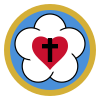
Luther rose
Lutherrose
VIIISub-branches
- Lutheran World Federation
- International Lutheran Council (more conservative)
IXOther Branches of Protestantism
 Pentecostal ChurchesPentecostalismThe youngest and fastest growing family, stressing that gifts of the Holy Spirit such as speaking in tongues, healing and prophecy are active today.
 Reformed and Presbyterian ChurchesReformed, PresbyterianStems from Zwingli in Zurich and Calvin in Geneva.
 Anglican CommunionAnglicanismSeparated from Rome in England in 1534, keeping bishops and the Book of Common Prayer.
 Methodist ChurchesMethodismGrew from John Wesley's movement within 18th-century Anglicanism and became separate after 1791.Lutheran ChurchesLutherische KircheThe first family, beginning with Martin Luther in 1517, with the Augsburg Confession of 1530 as its basic creed.
 BaptistsBaptistsBegins with John Smyth in Amsterdam in 1609.Uses the common symbol of the path
 Seventh-day AdventistsSeventh-day Adventist ChurchFormed in 19th-century America from the movement awaiting Christ's return.
 Christian and Missionary Alliance (CMA)Christian and Missionary AllianceFounded by A.
 Anabaptist and Mennonite ChurchesAnabaptism, MennonitesBegan in Zurich on 21 January 1525.
XSources
The library cross-checks the sources below. Where they disagree, the page gives both.
?Quick Questions
How do Lutherans differ from Catholics?
Mainly on justification by faith, the final authority of Scripture and the papacy. In form Lutherans keep much of the Catholic liturgy, vestments and church year. In 1999 the two signed a joint declaration on the doctrine of justification.
How do Lutherans differ from other Protestants?
They keep more historic liturgy, baptise infants and teach the real presence of Christ in communion. Reformed and Baptist churches removed more ritual and understand communion differently.
How many Lutherans are there?
The Lutheran World Federation reported 77,493,989 members in 148 churches at the end of 2019. Some conservative Lutheran churches are outside the federation, so the real total is higher.
Is there a Lutheran church in Vietnam?
No Lutheran body is among the 11 recognised Protestant organisations. According to a 2019 source, a Hmong church in Vietnam receives theological training from an American Lutheran synod.