
IOverview
Vietnamese call Mahayana Buddhism Bắc Tông, the Northern lineage, because it travelled overland through Central Asia into China and on to Korea, Japan and Vietnam. The word Northern names the route of transmission, not any church or headquarters.
Mahayana is not an organisation. It is a broad current that contains many schools. They share the Four Noble Truths, the Eightfold Path and the basic monastic rules with Theravada, and add one defining ideal: the bodhisattva, who vows to reach Buddhahood in order to free all beings rather than seeking release alone. Its main scriptural collection is the Chinese canon, made up of translations from Sanskrit and Central Asian languages together with treatises written by Chinese masters.
According to Wikipedia's Theravada article, citing the World Religion Database for 2010, roughly 53 percent of the world's Buddhists follow Mahayana. Pew Research Center put the total number of Buddhists at about 324 million as of 2020.
IIOrigins and History
Historians cannot point to a founding date. The earliest texts with a clearly Mahayana outlook, such as the Perfection of Wisdom sutras, appeared in India between about the 1st century BCE and the 1st century CE. Only after reaching China did the name Mahayana harden into the label of a separate tradition.
- 1st c. BCE to 1st c. CEPerfection of Wisdom sutrasTexts on emptiness and the bodhisattva path that became the foundation of Mahayana thought.
- 2nd centuryNagarjuna and MadhyamakaNagarjuna systematised the teaching of emptiness in his Middle Way treatises.
- 2nd centuryTranslation in Luoyang and Luy LauAn Shigao and Lokaksema began rendering sutras into Chinese. Luy Lau in the Red River delta was another early translation centre.
- 4th to 5th c.Asanga, Vasubandhu and YogacaraThe two brothers founded the Yogacara school, later known in China as the Consciousness Only school.
- 401Kumarajiva reaches Chang'anHis translations of the Lotus, Diamond and Amitabha sutras are still chanted today.
- 6th centuryChinese schools take shapeZhiyi founds Tiantai, and Chan traces its lineage to Bodhidharma.
- 645Xuanzang returns to Chang'anHe brought back more than 600 texts and launched a major translation effort.
IIITeachings and Distinctive Features
Mahayana calls itself the Great Vehicle because it carries many. The practitioner awakens bodhicitta, the resolve to become a Buddha for the benefit of all beings, and follows the six perfections: generosity, ethics, patience, effort, meditation and wisdom. All beings are said to possess Buddha nature, the capacity to become a Buddha.
Features that are often singled out:
- Emptiness: all phenomena arise from conditions and have no fixed self nature, as taught in the Perfection of Wisdom literature and Madhyamaka.
- Three bodies of the Buddha: the Dharma body, the enjoyment body and the emanation body. The historical Buddha is understood as an emanation in this world.
- Many Buddhas and many worlds: alongside Shakyamuni, devotees honour Amitabha and the Medicine Buddha, and bodhisattvas such as Avalokitesvara, Manjusri, Samantabhadra and Ksitigarbha.
- Key scriptures: the Lotus, Avatamsaka, Perfection of Wisdom, Diamond, Vimalakirti, Surangama and Amitabha sutras.
Theravada is often called Hinayana, the Lesser Vehicle, as if it were the small cart beside the large one. Hinayana was a polemical term in Mahayana sutras aimed at certain early Indian schools. It was never Theravada's name for itself, and many scholars and Buddhist bodies today avoid using it for Theravada.
IVPractice, Ritual and Daily Life
A typical temple routine combines sutra chanting, recitation of the Buddha's name, mantras and seated meditation, with the balance depending on the school. Monks and nuns take the Dharmaguptaka Vinaya ordination and usually add the bodhisattva precepts of the Brahma Net Sutra.
In China, Vietnam and Korea, monastics are lifelong vegetarians. The custom is linked to the 6th century edicts of Emperor Wu of Liang and to the Brahma Net Sutra's precept against eating meat. Most Japanese priests, by contrast, marry and are not required to be vegetarian, a pattern that took hold in the Meiji era.
Lay followers take refuge in the Three Jewels, keep the five precepts and visit the temple on the full and new moon. Major occasions include the Buddha's birthday, the Ullambana festival for honouring parents and the feast days of Avalokitesvara. Memorial rites, food offerings for wandering spirits and repentance ceremonies are familiar Mahayana rituals in Vietnamese life.
VOrganisation and Distribution
Mahayana has no central authority. Each country organises itself. China has the Buddhist Association of China. In Japan every school is an independent body with its own head temple. In South Korea the Jogye Order is the largest.
| Place | Figure | Source and year |
|---|---|---|
| China | About 28,000 Han Buddhist temples | Chinese government white paper, 2018 |
| South Korea | 15.5 percent of the population identify as Buddhist | South Korean census, 2015 |
| Vietnam | 55,011 monks and nuns, over 19,000 monasteries across all lineages | Vietnam Buddhist Sangha, June 2023 |
VIIn Vietnam
Buddhism reached the Red River delta in the first centuries CE, centred on Luy Lau in today's Bac Ninh. From the period of Chinese rule through the Ly and Tran dynasties, the mainstream was Chinese language Mahayana. Under the Tran, King Tran Nhan Tong founded the Truc Lam Zen school. In the 17th and 18th centuries the Linji and Caodong lines arrived from China, and the Lieu Quan branch of Linji grew up in the southern domain and spread across central and southern Vietnam.
Vietnamese temples rarely follow a single school. One morning service may include sitting meditation, recitation of Amitabha's name and the Great Compassion mantra, that is Zen, Pure Land and esoteric practice in one sitting. Many northern temples also house shrines to the Mother Goddesses and local saints behind the Buddha hall.
On 7 November 1981, nine organisations and lineages merged to form the Vietnam Buddhist Sangha. The Northern lineage is the largest within it, alongside Khmer Theravada, Vietnamese Theravada and Khất Sĩ.
VIISymbol of the Branch
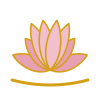
Lotus
Padma 蓮華
VIIISub-branches
- Chan and Zen
- Pure Land
- Esoteric (Mizong, Shingon)
- Vinaya
- Huayan
- Tiantai
- Yogacara
- Madhyamaka (Sanlun)
IXOther Branches of Buddhism
Mahayana BuddhismMahāyāna 大乘, the Great VehicleThe largest branch, centred on the bodhisattva ideal of liberating oneself and others. Theravada BuddhismTheravāda, the teaching of the eldersThe second largest branch.
 Vajrayana BuddhismVajrayāna, Tibetan rdo rje theg pa, also Mantrayana or Esoteric BuddhismThe branch that uses mantra, mudra and mandala visualisation, with a strong role for the teacher.
 Pure Land Buddhism淨土宗, also called the Lotus School 蓮宗, Japanese JōdoA Mahayana school centred on reciting the name of Amitabha Buddha for rebirth in the Pure Land.
 Chan and Zen Buddhism禪 Chan, Japanese Zen, Korean Seon, Vietnamese Thiền, from Sanskrit dhyānaA Mahayana school that points directly to the mind rather than relying on scripture.
 Khmer Theravada Buddhism in VietnamTheravāda of the Khmer of southern VietnamThe Theravada tradition of the Khmer people in the Mekong Delta.Uses the common symbol of the pathKhất Sĩ BuddhismĐạo Phật Khất Sĩ Việt Nam, Vietnamese Mendicant BuddhismA Vietnamese lineage founded in the South by Patriarch Minh Đăng Quang around 1944 to 1946.Uses the common symbol of the pathVietnamese (Kinh) TheravadaTheravāda among the Kinh, formerly called Original BuddhismThe Theravada lineage among ethnic Vietnamese, begun at Bửu Quang temple in Thủ Đức in 1938 by monks including Hộ Tông (Vansarakkhita), Thiện Luật, Bửu Chơn and Huệ Nghiêm.Uses the common symbol of the path
XSources
The library cross-checks the sources below. Where they disagree, the page gives both.
?Quick Questions
Are Bac Tong and Mahayana the same thing
Yes. Bắc Tông is the Vietnamese name based on the northern route of transmission, while Mahayana is the name based on doctrine. Both refer to the tradition that travelled through Central Asia and China.
How does Mahayana differ from Theravada
Both accept the Four Noble Truths and the Eightfold Path. Mahayana uses the Chinese canon, aims at Buddhahood through the bodhisattva path, venerates many Buddhas and bodhisattvas, and in Vietnam its monastics are vegetarian. Theravada uses the Pali canon, aims at arahantship, and its monks go on alms rounds without a vegetarian rule.
Which school do Vietnamese temples belong to
Most are Mahayana and most trace their lineage to Linji. In practice they blend Zen, Pure Land and esoteric elements, so labelling a Vietnamese temple with one school usually tells only part of the story.
Must Mahayana monks be vegetarian
In Vietnam, China and Korea, Mahayana monks and nuns are vegetarian under the bodhisattva precepts. In Japan it is not required, and most priests are married.