
IOverview
Pure Land Buddhism teaches practitioners to recite the name of Amitabha Buddha, trust in his vows and aspire to rebirth in his land of Sukhavati, the Land of Bliss. The everyday Vietnamese phrase Nam mô A Di Đà Phật is its most visible trace.
It belongs to Mahayana and rests on three sutras known together as the Pure Land sutras: the Larger Sukhavativyuha, the Contemplation Sutra and the Smaller Sukhavativyuha, or Amitabha Sutra. In China and Vietnam, Pure Land is rarely a separate church. It is a practice shared by almost every Mahayana temple. Only in Japan did Pure Land form independent denominations, and Jodo Shinshu is the most widely practised Buddhist tradition in that country.
IIOrigins and History
Devotion to Amitabha's land was present in India and Central Asia in the early centuries CE, and a sutra on visualising the Buddhas was translated into Chinese in the late 2nd century. Chinese tradition honours Huiyuan as the first patriarch, but historians see Tanluan, Daochuo and Shandao in the 6th and 7th centuries as the figures who made Pure Land a distinct current.
- 402White Lotus SocietyHuiyuan and 123 companions vow together to be reborn in the Western Paradise on Mount Lu. The name Lotus School comes from this.
- 6th centuryTanluanHis commentary on Vasubandhu's treatise lays the ground for relying on the Buddha's other power.
- 7th centuryShandaoHe champions oral recitation of the name, with lasting influence on Japanese Pure Land.
- 10th centuryYongming YanshouHe advocates joint practice of Chan and Pure Land, the model still followed in Chinese and Vietnamese temples.
- 1175Honen founds Jodo-shuHe teaches that exclusive recitation of the name is sufficient for rebirth.
- 13th centuryShinran and Jodo ShinshuHonen's disciple teaches that faith is the heart of the path and lives as a married cleric.
- 1602West and East Hongan-jiJodo Shinshu divides into two main branches that continue today.
IIITeachings and Distinctive Features
According to the Larger Sukhavativyuha, Amitabha, while still the monk Dharmakara, made 48 vows, including the promise that those who sincerely call his name will be born in his land. Pure Land practitioners hold to faith, aspiration and practice: trust in the vows, the wish for rebirth and the recitation of the name.
- Other power and self power: most schools stress one's own effort. Pure Land stresses the power of the Buddha's vow. In China and Vietnam the two are usually seen as working together.
- Four ways of recollecting the Buddha: reciting the name, contemplating the Pure Land, contemplating an image and contemplating ultimate reality. Reciting the name is by far the most common.
- The Shin emphasis: Shinran taught that even faith is given by Amida. Recitation expresses gratitude rather than earning rebirth.
The Land of Bliss is often pictured as a heaven for enjoying reward forever. In the Pure Land sutras it is a realm with ideal conditions for continuing practice until Buddhahood. Many Pure Land teachers also speak of the Pure Land as the purified mind, following the saying that when the mind is pure, the land is pure.
IVPractice, Ritual and Daily Life
The basic practice is reciting Nam mô A Di Đà Phật, aloud or silently, often counted on prayer beads. The evening service in Vietnamese Mahayana temples usually includes the Amitabha Sutra and recitation of the name. Many temples hold seven day recitation retreats.
Pure Land is closely tied to care for the dying. Family members and volunteer groups sit by the bedside and recite so that the dying person can keep a clear, settled mind. The 17th day of the 11th lunar month is kept as Amitabha's feast day in many Vietnamese and Chinese temples.
In Japan, Pure Land followers recite Namu Amida Butsu. Jodo Shinshu priests marry, and temples are often passed down within a family.
VOrganisation and Distribution
In China, Taiwan and Vietnam, Pure Land has no church of its own. It lives within Mahayana temples, recitation halls and lay associations. Chinese tradition counts thirteen Pure Land patriarchs, from Huiyuan to Yinguang, who died in 1940.
In Japan, Jodo-shu has its head temple at Chion-in in Kyoto. Jodo Shinshu has two main branches: Hongwanji, headquartered at Nishi Hongan-ji, and Otani, headquartered at Higashi Hongan-ji. Wikipedia's Jodo Shinshu article describes it as the most widely practised form of Buddhism in Japan, but no reliable dated membership figure was found. Japanese emigrants took Jodo Shinshu to Hawaii and North America, where it became the Buddhist Churches of America.
VIIn Vietnam
In Vietnam, Pure Land is not a separate lineage within the Vietnam Buddhist Sangha. It is the most widespread practice in Mahayana temples and in Buddhist homes. Nam mô A Di Đà Phật serves as a greeting, a phrase for difficult moments and a farewell to the dead. Temples follow joint Zen and Pure Land practice, with meditation in the morning and the Amitabha Sutra in the evening.
Outside the Sangha stands the Vietnam Pure Land Lay Buddhist Association, founded in the South in 1934 by Nguyen Van Bong, known by his Dharma name Minh Tri. It pairs recitation with charitable work, and each of its halls runs a free traditional medicine clinic. According to the Association, it had 206 halls from Khanh Hoa to Ca Mau in 2006. The Government Committee for Religious Affairs recognised it as a religious organisation by a decision of 27 November 2007, and it operates independently of the Vietnam Buddhist Sangha.
VIISymbol of the Branch
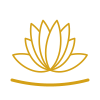
Lotus, after the name Lotus School
蓮
VIIISub-branches
- Jōdo-shū
- Jōdo Shinshū
- Ji-shū
IXOther Branches of Buddhism
 Mahayana BuddhismMahāyāna 大乘, the Great VehicleThe largest branch, centred on the bodhisattva ideal of liberating oneself and others.
 Theravada BuddhismTheravāda, the teaching of the eldersThe second largest branch.
 Vajrayana BuddhismVajrayāna, Tibetan rdo rje theg pa, also Mantrayana or Esoteric BuddhismThe branch that uses mantra, mudra and mandala visualisation, with a strong role for the teacher.Pure Land Buddhism淨土宗, also called the Lotus School 蓮宗, Japanese JōdoA Mahayana school centred on reciting the name of Amitabha Buddha for rebirth in the Pure Land.
 Chan and Zen Buddhism禪 Chan, Japanese Zen, Korean Seon, Vietnamese Thiền, from Sanskrit dhyānaA Mahayana school that points directly to the mind rather than relying on scripture.
 Khmer Theravada Buddhism in VietnamTheravāda of the Khmer of southern VietnamThe Theravada tradition of the Khmer people in the Mekong Delta.Uses the common symbol of the pathKhất Sĩ BuddhismĐạo Phật Khất Sĩ Việt Nam, Vietnamese Mendicant BuddhismA Vietnamese lineage founded in the South by Patriarch Minh Đăng Quang around 1944 to 1946.Uses the common symbol of the pathVietnamese (Kinh) TheravadaTheravāda among the Kinh, formerly called Original BuddhismThe Theravada lineage among ethnic Vietnamese, begun at Bửu Quang temple in Thủ Đức in 1938 by monks including Hộ Tông (Vansarakkhita), Thiện Luật, Bửu Chơn and Huệ Nghiêm.Uses the common symbol of the path
XSources
The library cross-checks the sources below. Where they disagree, the page gives both.
?Quick Questions
What does Nam mo A Di Da Phat mean
Nam mô renders the Sanskrit namo, meaning homage. The phrase means homage to Amitabha Buddha. Amitabha means infinite light, and his other name Amitayus means infinite life.
Are Pure Land and Zen opposed
In Japan they are separate schools. In China and Vietnam, joint practice of Chan and Pure Land has been advocated since the 10th century, so most Vietnamese temples practise both in the same daily routine.
Which sutras does Pure Land rely on
The three main texts are the Larger Sukhavativyuha, the Contemplation Sutra and the Amitabha Sutra. The Amitabha Sutra is short and chanted daily in Vietnamese temples.
Is the Pure Land Lay Buddhist Association the same as the Pure Land school
It is a Vietnamese lay organisation founded in 1934 that practises recitation and charitable herbal medicine. It was recognised in 2007 and runs independently of the Vietnam Buddhist Sangha, so it is one organisation within Pure Land practice rather than the school as a whole.