
IOverview
Folk Shinto 民俗神道 names the layer of kami worship that Japanese people keep by household and village custom, through no organisation and with no one to explain it. A small altar shelf high on a wall, a talisman pasted in the kitchen, a carved stone at the fork in the road outside the village, a shared drink after the harvest rite: all belong here.
The Association of Shinto Shrines counts this as one of the four forms of Shinto and describes it as Shinto faith practised by ordinary people as custom, without systematisation. The key phrase is without systematisation. Folk Shinto has no leader, no standard text and no clear border with Buddhism, Taoism or Confucian thought. One household may honour the hearth kami, keep a Buddhist altar, the butsudan, and observe taboos on days drawn from yin-yang divination.
IIHistory and Naming
The Association of Shinto Shrines explains that the folk layer parted from Shrine Shinto when the court of Emperor Tenmu, around 673 to 686, standardised state ritual. It later absorbed elements of Buddhism, Taoism and Confucianism while keeping its core of kami worship.
Folk Shinto is a scholar's term, not one people use of themselves. It is tied to Japanese folklore studies, founded by Yanagita Kunio (1875 to 1962). Yanagita and his students travelled the villages recording rites, festivals and tales, and proposed influential theories, such as the idea that the mountain kami descends in spring to become the kami of the rice fields and returns after the harvest. Those theories are still debated.
IIIThe Kami of Everyday Life
Folk Shinto has no doctrine, but it has a crowded world of kami tied to particular places in daily life. Names vary by region, so those below are only the most common.
| Kami | Characters | Where it dwells and what it guards |
|---|---|---|
| Hearth kami | 荒神, 竈神 | The household fire, guarding fire and home |
| Water kami | 水神 | Wells, springs, irrigation channels |
| Compound kami | 屋敷神 | A small shrine in the corner of the garden, guarding a household or lineage |
| Field kami | 田の神 | Rice fields, welcomed in spring and sent off after harvest |
| Mountain kami | 山の神 | Mountains and forests, respected by foresters, hunters and charcoal makers |
| Dōsojin | 道祖神 | Village edges and crossroads, blocking harm from outside and guarding travellers |
Misconception: Folk Shinto is a separate denomination. In fact: it is a layer of custom, not a group of people. Those who honour the hearth kami usually also visit their local shrine, and nobody calls themselves a Folk Shinto believer.
IVCustom, Seasonal and Life-Cycle Rites
The kamidana 神棚 is the most visible element: a wooden shelf set high on the wall, holding a miniature shrine, talismans from Ise and the local shrine, and offerings of water, salt, rice and sakaki branches. Each morning someone changes the water, bows and claps. Many shops and small workshops have one too.
In villages, worship often runs on rotating duty. The Association of Shinto Shrines mentions the tōya 頭屋 custom, in which one household or person, often a young man, takes charge of the village kami for a year. The Kinki region has miyaza 宮座, shrine guilds of long-established families. Many places also have kō 講, confraternities that pool money to send members on distant pilgrimages, such as to Ise or up Mount Fuji.
- Seasonal rites: welcoming the field kami at planting, thanks at harvest, New Year, midyear purification.
- Life-cycle rites: presenting infants at the shrine, coming of age, protection in unlucky years.
- Taboos: bad days and bad directions, many drawn from yin-yang divination.
VOrganisation and Distribution
Folk Shinto has no organisation. Its units are the household, the hamlet, the village and the confraternity. It therefore has no membership figure and does not appear as a category in Japan's religious statistics. What can be measured is practice. A Pew Research survey published in 2024 found that 70 percent of Japanese adults had made food or drink offerings to ancestors in the previous twelve months, a figure that speaks to the reach of household custom rather than of a religion.
The layer is thinning with urbanisation. Apartments have no hearth for a hearth kami, and emptying villages struggle to fill the tōya role. At the same time many customs survive as cultural activity, and village festivals are preserved by local governments as heritage.
VIIn Vietnam
Folk Shinto has no presence in Vietnam, and by its nature could not exist there as an organisation. Vietnamese readers will nonetheless see many parallels with their own folk religion: the hearth kami recalls the Kitchen God, Ông Táo, the compound kami recalls the household earth spirit, thổ công, dōsojin recall shrines at the village gate, and the rotating tōya duty recalls the custom of sharing duties at the communal house. The likeness comes from a shared rice-farming culture and the wider Sinographic sphere, not from one borrowing from the other.
VIISymbol of the Branch
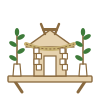
Kamidana (household shrine shelf)
神棚
VIIIOther Branches of Shinto
 Shrine Shinto神社神道 Jinja ShintōThe largest form, centred on the nationwide network of shrines.Folk Shinto民俗神道 Minzoku ShintōCustomary Shinto practised by ordinary people without systematisation: household altars, kami of the kitchen and well, village customs, seasonal and life-cycle rites.
 Sect Shinto教派神道 Kyōha Shintō (called 宗派神道 Shūha Shintō by the Association of Shinto Shrines)Organised groups with founders, doctrines and members, mostly formed in the 19th century.Uses the common symbol of the path
 Izumo Ōyashirokyō出雲大社教 Izumo ŌyashirokyōFounded in 1882 by Senge Takatomi, 80th chief priest of Izumo Taisha.Konkōkyō金光教 KonkōkyōFounded in 1859 by Konkō Daijin, headquartered in Asakuchi, Okayama.Uses the common symbol of the pathKurozumikyō黒住教 KurozumikyōFounded by Kurozumi Munetada, dated to 1814, headquartered at Shintōzan in Okayama.Uses the common symbol of the path
 Ōmoto大本 ŌmotoBegan with Deguchi Nao in 1892 in Ayabe, Kyoto.
 Imperial Household Shinto皇室神道 Kōshitsu ShintōRites performed by the Emperor within the palace for the nation, the people and world peace, centred on Amaterasu.Historical Shinto schools両部神道, 吉田神道, 伊勢神道, 垂加神道, 復古神道Interpretive schools from the medieval to early modern period, including Ryōbu, Ise, Yoshida, Suika and Fukko Shinto.Uses the common symbol of the path
IXSources
The library cross-checks the sources below. Where they disagree, the page gives both.
?Quick Questions
Is Folk Shinto a sect?
No. It is a scholarly term for the layer of kami worship among ordinary people, with no leader and no membership. The Association of Shinto Shrines lists it as one of four forms of Shinto.
What is a kamidana?
A kamidana is a kami altar shelf set high on the wall of a home or shop, holding talismans from Ise and the local shrine, with offerings of water, salt, rice and sacred branches. It is the most visible sign of Folk Shinto.
How many people practise Folk Shinto?
It cannot be counted, as there is no organisation or membership. A Pew survey published in 2024 could only measure practice, for example that 70 percent of Japanese adults made ancestral offerings in the past year.