
IOverview
For most outsiders, Shinto means a red torii gate, a hall with a sweeping roof and worshippers clapping their hands before the altar. All of that belongs to Shrine Shinto 神社神道, the largest and most visible form of the tradition. The name says what it is: Shinto organised around the shrine.
It has no founder, no binding scripture and no creed to recite. What has held it together for centuries is a network of shrines covering villages and city wards, a standardised body of ritual, and the bond between each shrine and the people living in its parish. The protective kami of a locality is its ujigami 氏神, and the residents are its ujiko 氏子. You become an ujiko by living there, not by signing up.
The Association of Shinto Shrines 神社本庁, which oversees most shrines in the country, describes Shrine Shinto as one of four forms of Shinto, alongside Imperial Household Shinto, Sect Shinto and Folk Shinto. The four overlap.
IIHistorical Development
Worship of kami at fixed places is very old. At first the sacred site might be a mountain, a rock or a fenced grove, and wooden sanctuaries came later. The ancient court kept registers of shrines entitled to state offerings, and the Engishiki, completed in 927, lists 2,861 of them. For more than a thousand years afterwards shrines and Buddhist temples were intertwined, and many shrines were run by monks.
- 1868Separation of kami and buddhasThe shinbutsu bunri orders strip Buddhist elements from shrines.
- 1868 to 1945State ShintoShrines are administered, ranked and funded by the state.
- 15 Dec 1945Shinto DirectiveThe Allied occupation ends state sponsorship of shrines.
- 3 Feb 1946Association of Shinto Shrines foundedThree earlier bodies merge, with Ise Jingū as head shrine.
- 201362nd Shikinen Sengū at IseThe sanctuaries are rebuilt under the twenty-year custom.
IIIBeliefs and Distinctive Features
Shrine Shinto is thin on doctrine and thick on practice. There is no confession of faith and no rite of conversion. What matters is doing things properly: purifying oneself before approaching the kami, making offerings in their season, reciting norito prayers in the correct form. The moral axis is purity and pollution rather than good and evil in the scriptural sense.
The Association of Shinto Shrines describes itself as a body that honours Ise Jingū as its head shrine, reveres Amaterasu, and prays for the peace of the nation and the happiness of the people. It has issued guidelines for those who revere the kami, stressing gratitude, sincerity and service to the community.
A second feature is diversity by kami network. Each shrine honours one or more kami of its own, and shrines to the same kami form networks with a head shrine, or sōhonsha 総本社. The Inari network honours the kami of rice and prosperity, with its head at Fushimi Inari Taisha in Kyoto. Hachiman is linked to warriors and protection, with its head at Usa Jingū. Tenjin shrines honour the scholar Sugawara no Michizane as kami of learning.
IVRitual and Everyday Life
Shrine life runs on three cycles. The yearly cycle has the New Year visit, hatsumōde, spring rites for the crops, autumn thanksgiving, and the great local matsuri, when the kami is carried through the streets in a portable shrine, the mikoshi. Twice a year, at the end of June and the end of December, many shrines hold the Great Purification, Ōharae 大祓, to clear away accumulated impurity.
The life cycle brings newborns to be presented to the kami, shichi-go-san for children aged three, five and seven, weddings before the kami, and protective rites in years considered unlucky. The cycle of work adds groundbreaking rites, jichinsai, before building, and blessings for new cars and new shops. Funerals, by contrast, mostly go to Buddhist temples, a division of labour long settled.
VOrganisation and Distribution
The Association of Shinto Shrines was founded on 3 February 1946 and is based in Tokyo, with a shrine office in each prefecture. Its own website says it covers about eighty thousand shrines. Its work is administrative and educational: training priests, distributing Ise talismans to local shrines, publishing, and maintaining ritual standards.
Shrine clergy are called shinshoku, and each shrine is headed by a gūji. Priests are not monastics. They marry, and at many small shrines the office passes down a family.
Not every shrine belongs to the Association. Some major shrines are independent corporations, including Fushimi Inari Taisha in Kyoto and Yasukuni Jinja in Tokyo. The Agency for Cultural Affairs counted 84,113 Shinto religious corporations as of 31 December 2023, a figure that includes shrines outside the Association as well as the sects.
| Network | Main kami | Head shrine usually cited |
|---|---|---|
| Inari | Inari Ōkami, kami of rice and prosperity | Fushimi Inari Taisha, Kyoto |
| Hachiman | Hachiman, linked to Emperor Ōjin | Usa Jingū, Ōita |
| Tenjin | Sugawara no Michizane | Dazaifu Tenmangū and Kitano Tenmangū |
| Shinmei | Amaterasu | Ise Jingū, Mie |
VIIn Vietnam
Shrine Shinto has no organisation, no shrine and no legal standing in Vietnam. According to figures released by the Government Committee for Religious Affairs on 1 August 2025, Vietnam recognises 16 religions and 43 registered religious organisations, and Shinto is not among them.
Vietnamese readers will still find much that is familiar: a shrine whose kami protects a locality resembles the village communal house that honours a tutelary spirit, and the mikoshi procession resembles a village festival.
VIISymbol of the Branch
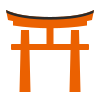
Torii gate
鳥居
VIIISub-branches
- Shrines within the Association of Shinto Shrines (Jinja Honchō)
- Independent shrines outside it, such as Fushimi Inari Taisha
- Major cults by kami: Inari, Hachiman, Tenjin (Tenmangū), Shinmei (Ise)
IXOther Branches of Shinto
Shrine Shinto神社神道 Jinja ShintōThe largest form, centred on the nationwide network of shrines. Folk Shinto民俗神道 Minzoku ShintōCustomary Shinto practised by ordinary people without systematisation: household altars, kami of the kitchen and well, village customs, seasonal and life-cycle rites.
 Sect Shinto教派神道 Kyōha Shintō (called 宗派神道 Shūha Shintō by the Association of Shinto Shrines)Organised groups with founders, doctrines and members, mostly formed in the 19th century.Uses the common symbol of the path
 Izumo Ōyashirokyō出雲大社教 Izumo ŌyashirokyōFounded in 1882 by Senge Takatomi, 80th chief priest of Izumo Taisha.Konkōkyō金光教 KonkōkyōFounded in 1859 by Konkō Daijin, headquartered in Asakuchi, Okayama.Uses the common symbol of the pathKurozumikyō黒住教 KurozumikyōFounded by Kurozumi Munetada, dated to 1814, headquartered at Shintōzan in Okayama.Uses the common symbol of the path
 Ōmoto大本 ŌmotoBegan with Deguchi Nao in 1892 in Ayabe, Kyoto.
 Imperial Household Shinto皇室神道 Kōshitsu ShintōRites performed by the Emperor within the palace for the nation, the people and world peace, centred on Amaterasu.Historical Shinto schools両部神道, 吉田神道, 伊勢神道, 垂加神道, 復古神道Interpretive schools from the medieval to early modern period, including Ryōbu, Ise, Yoshida, Suika and Fukko Shinto.Uses the common symbol of the path
XSources
The library cross-checks the sources below. Where they disagree, the page gives both.
?Quick Questions
How does Shrine Shinto differ from Shinto in general?
Shrine Shinto is one of four forms of Shinto, the one centred on shrines. The others are the rites of the imperial palace, the founded sects, and folk custom. When general books speak of Shinto, they are mostly describing this form.
Is the Association of Shinto Shrines a church?
Not really. It is an administrative body covering about eighty thousand shrines, training priests and maintaining ritual standards, but it has no authority over belief. Some major shrines, such as Fushimi Inari Taisha, stand outside it.
How many people follow Shrine Shinto?
There is no separate figure. The Agency for Cultural Affairs lists 83,371,429 adherents for Shinto as a whole at the end of 2023, but those are parish residents reported by shrines. A Pew survey published in 2024 found only 4 percent of adults naming Shinto as their religion.
Are there Shinto shrines in Vietnam?
No shrine or Shinto organisation is registered in Vietnam. Shrines outside Japan were mostly founded by Japanese emigrant communities in Hawaii and Brazil.