IOverview
A visitor who knows Tay Ninh will find much that is unfamiliar at the Chon Ly Holy See in My Tho. There are four councils rather than three, and the central object of worship bears four words: Heart, Spirit, Reason, Truth.
Its charter name is Đại Đạo Tam Kỳ Phổ Độ, the Cao Dai Chon Ly Church, or Cao Dai Chon Ly for short. It is based at 193 Nguyen Trung Truc Street, My Phong commune, My Tho, former Tien Giang province, now part of Dong Thap. According to Nhip Cau Tam Giao the holy see covers about three hectares.
The charter states its principle as cultivating the human way, with self-cultivation as the root, guiding people toward goodness.
IIHistory
According to Nhip Cau Tam Giao, in 1928 Nguyen Van Ca, later called Anh lớn Thái Phối sư, founded the My Tho temple. On 17 June 1931 a first An Thiên assembly met in Rach Gia and named him head of the Cửu Trùng Đài.
The fifth term charter gives 1931 as the founding year, in My Tho, under Nguyen Van Ca. A biography on caodaichonly.org divides the early years into a Minh Chon Ly period from 1931 to 1937 and a Chon Ly Church period from 1938 to 1947. It describes Nguyen Van Ca as representing the body of the religion and Le Van Duoc its soul.
An overview on Nghien cuu lich su places the Minh Chon Ly period in Dinh Tuong and lists its three aims: rectifying the religion, receiving new members and publishing moral teaching.
- 1928My Tho templeNguyen Van Ca founds the temple.
- 1931An Thiên assemblyMeets in Rach Gia on 17 June. Founding year per the charter.
- 1938Chon Ly ChurchTransition from the Minh Chon Ly period to the Chon Ly Church.
- 2000Legal statusThe church is recognized by the state.
IIITeachings and Distinctive Features
The charter describes worship at the holy see as follows: a sacred emblem of Heart, Spirit, Reason and Truth, four tablets of the Four Saints, namely the Buddha, Laozi, Confucius and Jesus, and a stand of fifteen lamps.
The first difference is the four councils. Besides the Bát Quái Đài, Hiệp Thiên Đài and Cửu Trùng Đài found in other churches, Chon Ly adds a Châu Thiên Đài. The holy see also includes a Phổ Đà Cảnh garden shrine.
The second is the Four Saints, which place Jesus on the main altar alongside the founders of the Three Teachings.
The third is the flag. The Chon Ly flag of the Three Pure Ones has red for Confucianism, yellow for Buddhism and blue for Taoism, rectangular, its height two thirds of its length.
One compilation says Chon Ly uses a Tâm Nhãn, an eye of the heart. The charter itself names the emblem of Heart, Spirit, Reason and Truth. The library follows the charter and does not draw a Divine Eye as this branch's own symbol until a source describes the design.
IVPractice, Ritual and Daily Life
Under the charter the church's annual feasts are: New Spring, the First Seasonal Festival, Long Hoa, Tam Tôn, An Thiên, the Middle Seasonal Festival, Liên Hoa, the Last Seasonal Festival and Tu My, the founding feast. The regular assembly meets on 24 December in the solar calendar, at the Tu My feast.
Dignitaries from the rank of Lễ sanh upward have five sets of vestments, including a white fitted robe, a plain white robe, everyday dress and full ceremonial dress. The women's branch is divided into five houses: Quế, Diêu, Quỳnh, Liên and Bích.
VOrganization and Distribution
The church has two levels. At the centre sit the Council of Fifteen Lamps and a council of administrators. Local congregations have a management board and an executive board. The Council of Fifteen Lamps has no fixed term and fills vacancies by annual election.
| Level | Rank |
|---|---|
| 1 | Lễ sanh |
| 2 | Giáo hữu |
| 3 | Giáo sư |
| 4 | Phối sư |
| 5 | Chánh Phối sư |
| 6 | Tứ bửu |
| 7 | Ngũ Hành Thiên sư |
| 8 | Đầu sư |
| 9 | Chưởng quản |
VIToday
The Cao Dai Chon Ly Church was granted legal status by the state in 2000, according to a 2024 study in the Vietnam Social Sciences journal. It is a member of the Cao Dai inter-church liaison. Its fifth term charter (2020 to 2025) is published on the Government Committee for Religious Affairs site.
The church states its aim as a flourishing nation and a shining faith. There are no reliable figures for its followers or congregations. Since 2025 the holy see has been in Dong Thap province.
VIISymbol of the Branch
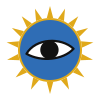
No symbol of its own is recorded with a source for this branch, so the library uses the common symbol of the path.
VIIIOther Branches of Caodaism
 Cao Dai Tay Ninh Holy SeeĐại Đạo Tam Kỳ Phổ Độ Tòa Thánh Tây NinhThe largest church, centred on the Tay Ninh Holy See.Cao Dai Ban Chinh DaoĐại Đạo Tam Kỳ Phổ Độ, Hội Thánh Ban Chỉnh Đạo, Tòa thánh An HộiSeparated from Tay Ninh in 1934, based at An Hoi in Ben Tre.Uses the common symbol of the pathCao Dai Tien ThienTiên Thiên Đại Đạo Tam Kỳ Phổ Độ, Hội thánh Cao Đài Tiên ThiênBased at Chau Minh in Ben Tre, founded 1937.Uses the common symbol of the pathCao Dai Missionary ChurchĐại Đạo Tam Kỳ Phổ Độ, Hội Thánh Truyền Giáo Cao Đài, Trung Hưng Bửu TòaThe main Cao Dai church of central Vietnam, based in Da Nang since 1956.Uses the common symbol of the pathCao Dai Minh Chon DaoĐại Đạo Tam Kỳ Phổ Độ, Hội Thánh Cao Đài Minh Chơn Đạo, Tòa thánh Ngọc SắcBased at Ngoc Sac in Ca Mau, rebuilt in 1954.Uses the common symbol of the pathCao Dai Cau Kho Tam QuanĐại Đạo Tam Kỳ Phổ Độ, Hội Thánh Cao Đài Cầu Kho Tam QuanBased at Tam Quan in Binh Dinh, founded 1954.Uses the common symbol of the path
 Chieu Minh LineageChiếu Minh Vô Vi, Chiếu Minh Tam Thanh Vô ViThe lineage of Ngo Van Chieu, first recipient of the Divine Eye in 1921.Cao Dai Chon LyĐại Đạo Tam Kỳ Phổ Độ, Hội thánh Cao Đài Chơn LýBased in My Tho, built around 1928 to 1931, one of the earliest branches.Uses the common symbol of the pathCao Dai Bach YBạch Y Liên Đoàn Chơn Lý, Tòa thánh Ngọc KinhAlso called Bach Y Lien Doan Chon Ly, based at Ngoc Kinh in Kien Giang since 1955.Uses the common symbol of the pathIndependent Cao Dai templesCao Đài Bảo Thủ Chơn Truyền, Cao Đài Pháp Chánh TruyềnTemples and followers outside the recognized churches, describing themselves as keepers of the original 1926 rule.Uses the common symbol of the path
IXSources
The library cross-checks the sources below. Where they disagree, the page gives both.
- Hiến chương Hội thánh Cao Đài Chơn Lý nhiệm kỳ V (2020 tới 2025), trang Ban Tôn giáo Chính phủ
- Cao Đài Chơn Lý, Thời kỳ Hội Thánh Chơn Lý, Tiểu sử Ngài Nguyễn Văn Ca
- Nhịp Cầu Tam Giáo, Các Tòa Thánh Đạo Cao Đài
- Nghiên cứu lịch sử, Khái quát về Đạo Cao Đài (2023)
- Nguyễn Thanh Xuân, Nguyễn Thị Quế Hương, Tạp chí Khoa học xã hội Việt Nam số 9 năm 2024
- Văn hóa tâm linh, Các Hội thánh, tổ chức Cao Đài
?Quick Questions
Where is the Chon Ly Holy See?
At 193 Nguyen Trung Truc Street, My Phong commune, former My Tho city, now part of Dong Thap province.
What does Chon Ly worship?
Under its charter the holy see honours an emblem of Heart, Spirit, Reason and Truth, four tablets of the Buddha, Laozi, Confucius and Jesus, and a stand of fifteen lamps.
When was Chon Ly recognized?
In 2000, according to a 2024 study in the Vietnam Social Sciences journal.
What is the Châu Thiên Đài?
It is the fourth council in the Chon Ly structure, alongside the Bát Quái Đài, Hiệp Thiên Đài and Cửu Trùng Đài. Other Cao Dai churches usually have three.