
IOverview
This entry is not about one church but about a phenomenon: Cao Dai temples and followers who do not belong to the churches recognized by the state.
They go by different names. According to a 2020 article in Luat Khoa, many temples call themselves Cao Đài Bảo Thủ Chơn Truyền, keepers of the true transmission, or followers of the Pháp Chánh Truyền, and say they practise the original teaching of the religion opened in 1926.
They should be distinguished from small independent Cao Dai organizations that are registered or recognized. For example, the Cao Dai Vietnam Church (Binh Duc) in former Tien Giang took shape in 1961 and was recognized in 2011. This page covers only the unregistered temples.
IIHistory
In 1997 the Cao Dai Tay Ninh Holy See church was granted legal status under a new charter. According to Luat Khoa in 2020, part of the faithful did not accept the leadership of that body, called it the 1997 Branch, and continued to worship separately in their own temples.
The phenomenon is not limited to Tay Ninh. Luat Khoa also cites a 2007 document of the Government Committee for Religious Affairs recording 40 Ban Chinh Dao temples that had not yet returned to the recognized church.
- 1926Claimed reference pointIndependent temples say they keep the rule of the founding.
- 1997New charterThe Tay Ninh church is recognized. Part of the faithful stays outside.
- 2007Committee documentRecords 40 Ban Chinh Dao temples outside the recognized church, as cited by Luat Khoa.
- 2018New law in forceThe 2016 Law on Belief and Religion takes effect on 1 January.
IIITeachings and Distinctive Features
The independent temples say they have not founded a new religion but keep the doctrine, scriptures and law of 1926 unchanged, including the Pháp Chánh Truyền and the New Code. According to Luat Khoa, they hold that the churches recognized since 1997 are subject to state involvement in religious practice. Some temples use their own scriptures.
In worship these temples use the common symbols of the faith: the Divine Eye, a left eye inside a circle and not in a triangle, and the three-coloured flag. No source describing a symbol of their own has been found. The difference lies in organization and relations with the state, not in the object of worship.
IVPractice, Ritual and Daily Life
Followers pray four times a day and keep the vegetarian days and five precepts like the rest of Cao Dai. The major feasts include the Supreme Being's day, the three seasonal festivals and the founding anniversary. Outside the recognized churches, these temples run their own local affairs and have no shared holy see.
VOrganization and Distribution
There is no common central body. Luat Khoa in 2020 named some temples: Phu Lam in former Phu Yen, Phu My and Nhon Ly in former Binh Dinh, Long Binh in Go Cong. There are no reliable figures for the total number of temples or followers.
The US State Department's 2019 International Religious Freedom Report on Vietnam lists independent Cao Dai among unregistered groups and records a case in Tien Giang where an unrecognized Cao Dai adherent was cited for holding a ritual without prior registration. The library records the report's content without assessing it.
VIToday
Under the 2016 Law on Belief and Religion, in force since 1 January 2018, collective religious activity must be registered with the authorities. The recognized Cao Dai churches operate within that framework. Most of the independent temples described here are not registered.
At the same time, some independent Cao Dai organizations and centres have received registration. According to a 2024 study in the Vietnam Social Sciences journal, the Cao Dai inter-church liaison had 18 members in 2023, including both organizations and individual centres. The library records these facts and does not judge which side is right.
VIISymbol of the Branch
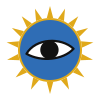
No symbol of its own is recorded with a source for this branch, so the library uses the common symbol of the path.
VIIIOther Branches of Caodaism
 Cao Dai Tay Ninh Holy SeeĐại Đạo Tam Kỳ Phổ Độ Tòa Thánh Tây NinhThe largest church, centred on the Tay Ninh Holy See.Cao Dai Ban Chinh DaoĐại Đạo Tam Kỳ Phổ Độ, Hội Thánh Ban Chỉnh Đạo, Tòa thánh An HộiSeparated from Tay Ninh in 1934, based at An Hoi in Ben Tre.Uses the common symbol of the pathCao Dai Tien ThienTiên Thiên Đại Đạo Tam Kỳ Phổ Độ, Hội thánh Cao Đài Tiên ThiênBased at Chau Minh in Ben Tre, founded 1937.Uses the common symbol of the pathCao Dai Missionary ChurchĐại Đạo Tam Kỳ Phổ Độ, Hội Thánh Truyền Giáo Cao Đài, Trung Hưng Bửu TòaThe main Cao Dai church of central Vietnam, based in Da Nang since 1956.Uses the common symbol of the pathCao Dai Minh Chon DaoĐại Đạo Tam Kỳ Phổ Độ, Hội Thánh Cao Đài Minh Chơn Đạo, Tòa thánh Ngọc SắcBased at Ngoc Sac in Ca Mau, rebuilt in 1954.Uses the common symbol of the pathCao Dai Cau Kho Tam QuanĐại Đạo Tam Kỳ Phổ Độ, Hội Thánh Cao Đài Cầu Kho Tam QuanBased at Tam Quan in Binh Dinh, founded 1954.Uses the common symbol of the path
 Chieu Minh LineageChiếu Minh Vô Vi, Chiếu Minh Tam Thanh Vô ViThe lineage of Ngo Van Chieu, first recipient of the Divine Eye in 1921.Cao Dai Chon LyĐại Đạo Tam Kỳ Phổ Độ, Hội thánh Cao Đài Chơn LýBased in My Tho, built around 1928 to 1931, one of the earliest branches.Uses the common symbol of the pathCao Dai Bach YBạch Y Liên Đoàn Chơn Lý, Tòa thánh Ngọc KinhAlso called Bach Y Lien Doan Chon Ly, based at Ngoc Kinh in Kien Giang since 1955.Uses the common symbol of the pathIndependent Cao Dai templesCao Đài Bảo Thủ Chơn Truyền, Cao Đài Pháp Chánh TruyềnTemples and followers outside the recognized churches, describing themselves as keepers of the original 1926 rule.Uses the common symbol of the path
IXSources
The library cross-checks the sources below. Where they disagree, the page gives both.
- Luật Khoa, Tôn giáo tháng Chín: Số phận của những thánh thất Cao Đài độc lập (2020)
- US Department of State, 2019 Report on International Religious Freedom: Vietnam (bản lưu trên ecoi.net)
- Ban Tôn giáo Chính phủ, Giáo hội Cao Đài Việt Nam (Bình Đức) tổ chức lễ kỷ niệm 60 năm thành lập (1961 tới 2021)
- Nguyễn Thanh Xuân, Nguyễn Thị Quế Hương, Tạp chí Khoa học xã hội Việt Nam số 9 năm 2024
- Wikipedia, Caodaism
?Quick Questions
What are independent Cao Dai temples?
Cao Dai temples and followers outside the churches recognized by the state. Many call themselves Cao Đài Bảo Thủ Chơn Truyền and say they keep the rule of 1926.
How do they differ from the recognized churches?
They worship the Supreme Being through the Divine Eye and share the same teaching. The difference is organizational: they do not accept the leadership of the church recognized in 1997 and are mostly unregistered.
Are any independent Cao Dai groups recognized?
Yes. The Cao Dai Vietnam Church (Binh Duc), for example, was recognized in 2011. Some other centres have received registration.