IOverview
For most people, Cao Dai means Tay Ninh. This is where the religion held its founding ceremony in 1926, where the Great Divine Temple stands, and it is the Cao Dai church with the largest number of temples today.
Its full name is the Cao Dai Church of the Tay Ninh Holy See, within the Great Way of the Third Universal Salvation. It keeps the three-council structure set out in the Pháp Chánh Truyền, the religious constitution. It worships the Supreme Being through the Divine Eye, honours the Mother Goddess at the Báo Ân Từ and at local shrines, and venerates the Three Saints who signed the covenant. Other Cao Dai churches share the same core teaching but differ in organization and in how much they stress public mission versus inner cultivation.
The Holy See lies about one hundred kilometres from Ho Chi Minh City, in a compound of roughly one square kilometre.
IIHistory
In the faith's own account, the Supreme Being revealed himself through a group of mediums in Saigon in 1925 and told them to join Ngo Van Chieu. Followers hold that the religion was founded by the Supreme Being through the séance, with human beings simply carrying out his instructions.
On 7 October 1926 a Declaration of the Religion was sent to the acting Governor of Cochinchina. The founding ceremony took place at Go Ken pagoda in Tay Ninh on the night of the 14th to the 15th of the tenth lunar month, which falls on 18 or 19 November 1926 depending on how the date is counted. The community then moved to Long Thanh, where the Holy See was built.
Le Van Trung (1876 to 1934) served as acting Pope. Pham Cong Tac (1890 to 1959) held the rank of Hộ Pháp, Defender of the Dharma, and was the most influential figure at Tay Ninh for decades. According to English Wikipedia, ground was broken for the temple in 1931, real construction began in 1936 after funding delays, and the building was finished in 1947.
- 1926FoundingDeclaration sent on 7 October. Founding ceremony at Go Ken pagoda in November.
- 1931GroundbreakingAccording to English Wikipedia. Real construction began in 1936.
- 1947Temple completedThree sections on an east west axis: Hiệp Thiên Đài, Cửu Trùng Đài, Bát Quái Đài.
- 1997Legal statusThe Cao Dai Tay Ninh Holy See church is granted legal status by the state.
- 2024CentenaryThe hundredth anniversary of the founding is celebrated at the Holy See on the evening of 14 November 2024.
IIITeachings and Distinctive Features
Doctrinally, Tay Ninh follows the shared Cao Dai framework: the Third Universal Salvation, returning the Three Teachings to their source and reuniting the Five Branches. Its core texts are the collected divine messages (Thánh Ngôn Hiệp Tuyển), the New Code (Tân Luật) and the constitution (Pháp Chánh Truyền).
What sets Tay Ninh apart is how fully it keeps the three councils the constitution describes. The Bát Quái Đài is the spiritual council governed by the Supreme Being. The Hiệp Thiên Đài guards religious law and communication with the unseen, headed by the Hộ Pháp. The Cửu Trùng Đài runs administration and mission, headed by the Pope, with nine ranks down to ordinary believers.
A second marker is the veneration of the Three Saints: Nguyen Binh Khiem, Victor Hugo and Sun Yat-sen, known in the faith by religious names. The painting of the Three Saints signing the covenant has hung in the Hiệp Thiên Đài since 1948. Not every Cao Dai church venerates them.
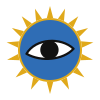
The Divine Eye at Tay Ninh is a left eye, painted on the cosmic globe in the Bát Quái Đài, or inside a circle in local temples. It is not placed in a triangle and is not the Western Eye of Providence. The faith explains the left eye through yin and yang: the left belongs to yang, and the Supreme Being governs the yang principle.
IVPractice, Ritual and Daily Life
Followers pray at four set times a day: midnight, dawn, noon and dusk. Each service offers flowers, wine and tea, standing for essence, vital energy and spirit. New members keep at least six vegetarian days a month, the five precepts and the four great rules of conduct.
At the Holy See the biggest festival of the year is the Supreme Being's feast on the ninth day of the first lunar month. The Mother Goddess banquet falls on the night of the 14th to the 15th of the eighth lunar month at the Báo Ân Từ. The founding anniversary is kept on the 14th and 15th of the tenth lunar month.
In major ceremonies the dignitaries walk ahead in three colours: yellow for the Buddhist branch, blue for the Taoist branch and red for the Confucian branch. Lay men and women wear white áo dài.
VOrganization and Distribution
The church is led today by a head holding the title Chưởng quản. At the 2024 centenary, VietnamPlus named Đầu sư Thượng Tám Thanh as head of the church.
The figures below were announced by the church. The Government Committee for Religious Affairs gives about 1.1 million followers for all Cao Dai as of June 2025. The two rest on different methods: church registers on one side, self-declared religion on the other.
| Measure | Figure | Source and year |
|---|---|---|
| Followers | Over 3 million | The church, centenary, 2024 |
| Temples | 451 | The church, 2024 |
| Mother Goddess shrines | 173 | The church, 2024 |
| Provinces with followers | 39, old boundaries | The church, 2024 |
According to a 2024 study by Nguyen Thanh Xuan and Nguyen Thi Que Huong in the Vietnam Social Sciences journal, the Tay Ninh church does not take part in the inter-church liaison that other Cao Dai organizations have run since 2008.
VIToday
The church was granted legal status by the state in 1997.
The Holy See is both a working religious centre and a major visitor site. The centenary celebration on the evening of 14 November 2024 drew representatives of the Government Committee for Religious Affairs and tens of thousands of followers from Vietnam and abroad.
Outside the recognized church there are some temples and followers who say they keep the rule of 1926 but do not belong to this church. The library covers them on a separate page about independent Cao Dai temples.
VIIOverseas
After 1975 many followers of the Tay Ninh tradition settled in the United States, Canada, France and Australia. They built local temples and associations and keep the same rites and vestments as at home. The Buddhist Studies Review in Vietnam mentions Cao Dai communities in North America, Cambodia, Europe and Australia. There are no reliable figures for followers abroad.
VIIISymbol of the Branch

Divine Eye on the Cosmic Globe
IXOther Branches of Caodaism
Cao Dai Tay Ninh Holy SeeĐại Đạo Tam Kỳ Phổ Độ Tòa Thánh Tây NinhThe largest church, centred on the Tay Ninh Holy See.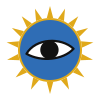 Cao Dai Ban Chinh DaoĐại Đạo Tam Kỳ Phổ Độ, Hội Thánh Ban Chỉnh Đạo, Tòa thánh An HộiSeparated from Tay Ninh in 1934, based at An Hoi in Ben Tre.Uses the common symbol of the pathCao Dai Tien ThienTiên Thiên Đại Đạo Tam Kỳ Phổ Độ, Hội thánh Cao Đài Tiên ThiênBased at Chau Minh in Ben Tre, founded 1937.Uses the common symbol of the pathCao Dai Missionary ChurchĐại Đạo Tam Kỳ Phổ Độ, Hội Thánh Truyền Giáo Cao Đài, Trung Hưng Bửu TòaThe main Cao Dai church of central Vietnam, based in Da Nang since 1956.Uses the common symbol of the pathCao Dai Minh Chon DaoĐại Đạo Tam Kỳ Phổ Độ, Hội Thánh Cao Đài Minh Chơn Đạo, Tòa thánh Ngọc SắcBased at Ngoc Sac in Ca Mau, rebuilt in 1954.Uses the common symbol of the pathCao Dai Cau Kho Tam QuanĐại Đạo Tam Kỳ Phổ Độ, Hội Thánh Cao Đài Cầu Kho Tam QuanBased at Tam Quan in Binh Dinh, founded 1954.Uses the common symbol of the path
 Chieu Minh LineageChiếu Minh Vô Vi, Chiếu Minh Tam Thanh Vô ViThe lineage of Ngo Van Chieu, first recipient of the Divine Eye in 1921.Cao Dai Chon LyĐại Đạo Tam Kỳ Phổ Độ, Hội thánh Cao Đài Chơn LýBased in My Tho, built around 1928 to 1931, one of the earliest branches.Uses the common symbol of the pathCao Dai Bach YBạch Y Liên Đoàn Chơn Lý, Tòa thánh Ngọc KinhAlso called Bach Y Lien Doan Chon Ly, based at Ngoc Kinh in Kien Giang since 1955.Uses the common symbol of the pathIndependent Cao Dai templesCao Đài Bảo Thủ Chơn Truyền, Cao Đài Pháp Chánh TruyềnTemples and followers outside the recognized churches, describing themselves as keepers of the original 1926 rule.Uses the common symbol of the path
XSources
The library cross-checks the sources below. Where they disagree, the page gives both.
- VietnamPlus, Tây Ninh: Lễ kỷ niệm 100 năm Hoằng khai Đại Đạo Tam Kỳ Phổ Độ (15 tháng 11 năm 2024)
- Nguyễn Thanh Xuân, Nguyễn Thị Quế Hương, Liên giao hành đạo giữa các tổ chức Cao Đài, Tạp chí Khoa học xã hội Việt Nam số 9 năm 2024
- Wikipedia, Great Divine Temple
- Wikipedia, Caodaism
- Nhịp Cầu Giáo Lý, Các Tòa Thánh Đạo Cao Đài
- Daotam, Thiên Nhãn và Quả Càn Khôn
?Quick Questions
Is the Tay Ninh Holy See the whole of Cao Dai?
No. It is the church with the most temples, but Cao Dai also includes Tien Thien, Ban Chinh Dao, the Missionary Church, Minh Chon Dao and others. They share the same core teaching and differ in organization.
When was the Tay Ninh church recognized?
It was granted legal status by the Vietnamese state in 1997, according to a 2024 study in the Vietnam Social Sciences journal and English Wikipedia.
How many followers does Tay Ninh have?
The church announced over 3 million followers at its 2024 centenary. The Government Committee for Religious Affairs gave about 1.1 million for all Cao Dai in 2025. The two figures count in different ways.
When was the Great Divine Temple built?
According to English Wikipedia, ground was broken in 1931, construction began in earnest in 1936 and the temple was completed in 1947.